

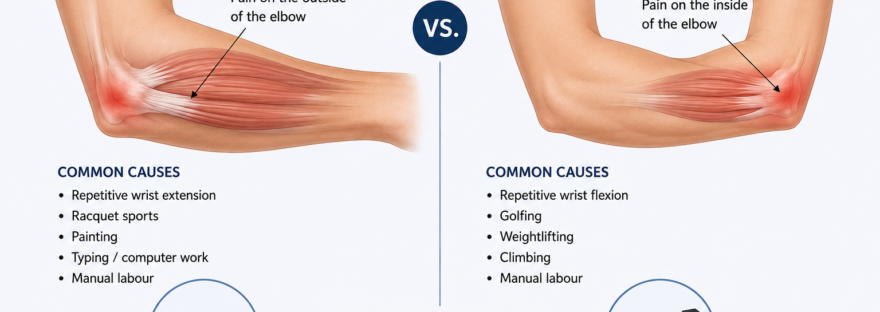
If you’ve been dealing with persistent elbow pain, you’ve probably come across the terms golfer’s elbow and tennis elbow. Despite their names, you don’t have to play golf or tennis to develop either condition.
At Durham Orthopedic & Sports Injury Clinic, we regularly treat patients throughout Ajax, Pickering, Whitby, Oshawa, and Durham Region experiencing elbow pain caused by repetitive work, sports, home renovations, weightlifting, and everyday activities. Our experienced physiotherapy team in Ajax helps identify the source of your pain and develop a personalized treatment plan designed to restore strength, reduce discomfort, and prevent future flare-ups.
So, what’s the difference between golfer’s elbow and tennis elbow?
What Is Tennis Elbow?
Tennis elbow, also known as lateral epicondylitis, affects the tendons on the outside of the elbow.
It develops when the muscles responsible for extending your wrist and fingers become overloaded through repetitive use. Tiny microscopic changes occur within the tendon over time, leading to pain and reduced function.
Despite its name, fewer than 10% of cases are actually caused by playing tennis.
Common causes include:
- Office work involving repetitive mouse use
- Construction and manual labour
- Painting
- Plumbing and electrical work
- Carpentry
- Gardening
- Weightlifting
- Racquet sports
Symptoms of Tennis Elbow
Patients often experience:
- Pain on the outside of the elbow
- Pain when gripping objects
- Difficulty opening jars
- Weak grip strength
- Pain when lifting a kettle or coffee mug
- Increased discomfort after repetitive activity
The pain may gradually worsen over several weeks or months if left untreated.
What Is Golfer’s Elbow?
Golfer’s elbow, or medial epicondylitis, affects the tendons on the inside of the elbow.
These tendons help bend your wrist and fingers. Like tennis elbow, repetitive stress causes the tendon to become irritated and painful.
Golf is only one possible cause.
Many patients who develop golfer’s elbow have never picked up a golf club.
Symptoms of Golfer’s Elbow
Symptoms commonly include:
- Pain along the inside of the elbow
- Tenderness near the bony bump on the inner elbow
- Pain when gripping or squeezing objects
- Discomfort when bending the wrist
- Weakness in the hand
- Occasionally tingling into the ring and little fingers if nearby nerves become irritated
The Biggest Difference
The easiest way to tell them apart is simply where the pain is located.
| Tennis Elbow | Golfer’s Elbow |
| Outside of elbow | Inside of elbow |
| Wrist extension causes pain | Wrist flexion causes pain |
| Common in painters, office workers, trades, racquet sports | Common in golfers, weightlifters, climbers, manual labourers |
Although the location differs, both conditions involve irritated tendons caused by repetitive loading rather than a sudden injury.
Why These Injuries Happen
Many people assume these injuries occur because they “overused” their arm over one weekend.
In reality, tendon injuries usually develop over time.
Common contributing factors include:
- Repetitive work tasks
- Poor lifting mechanics
- Sudden increase in activity
- Weak forearm muscles
- Reduced shoulder strength
- Poor posture
- Returning to sports too quickly
- Inadequate recovery between activities
Addressing these contributing factors is essential for long-term recovery.
Can It Heal on Its Own?
Some mild cases improve with temporary rest.
However, many people find the pain keeps returning because they haven’t addressed the underlying cause.
Simply avoiding activity often leads to:
- Reduced strength
- Decreased tendon capacity
- Recurring pain once activity resumes
This is why evidence-based rehabilitation is often much more effective than prolonged rest alone.
How Physiotherapy Can Help
One of the biggest misconceptions is that elbow pain simply needs time.
While reducing aggravating activities can help during the early stages, tendons actually respond well to progressive strengthening exercises.
During your assessment, your physiotherapist will determine whether you’re dealing with golfer’s elbow, tennis elbow, another tendon injury, or a different condition altogether.
Your personalized treatment plan may include:
- Comprehensive movement assessment
- Hands-on manual therapy
- Progressive strengthening exercises
- Grip strength training
- Stretching and mobility exercises
- Activity modification
- Education to prevent recurrence
- Return-to-work or return-to-sport planning
At Durham Orthopedic & Sports Injury Clinic, our goal isn’t just to reduce pain—we want to restore normal function so you can confidently return to work, sports, and everyday activities.
When Should You See a Physiotherapist?
You should consider booking an assessment if:
- Pain has lasted longer than two weeks
- Your grip feels weaker
- Everyday activities are becoming painful
- Symptoms continue returning
- You experience pain during work or sports
- Rest hasn’t improved your symptoms
Early treatment often helps prevent chronic tendon problems that can take much longer to recover.
Physiotherapy for Elbow Pain in Ajax
Whether you’re dealing with golfer’s elbow, tennis elbow, or another repetitive strain injury, early assessment can make a significant difference in your recovery.
At Durham Orthopedic & Sports Injury Clinic, our experienced physiotherapists in Ajax provide evidence-based treatment plans tailored to your goals. We proudly help patients from Ajax, Pickering, Whitby, Oshawa, and across Durham Region recover from elbow injuries, reduce pain, and get back to doing what they enjoy.
If elbow pain is affecting your work, hobbies, or daily activities, contact our team today to book a physiotherapy assessment and start your recovery.
