

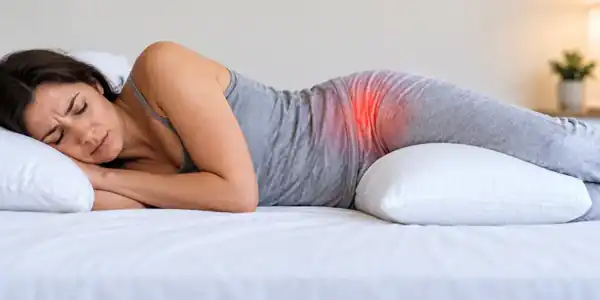
You finally get comfortable in bed, roll onto your side, and suddenly notice an aching pain around your hip.
Maybe the discomfort starts almost immediately. Other times, you wake up in the middle of the night and find yourself constantly switching positions to get comfortable.
Hip pain while sleeping on your side is a common complaint, and it can be especially frustrating when it begins interfering with your sleep.
While changing your sleeping position might provide temporary relief, ongoing hip pain can sometimes be related to irritated tendons, pressure on sensitive tissues, or changes in how your hip handles everyday activity.
At Durham Orthopedic & Sports Injury Clinic, our Ajax physiotherapy team can assess hip pain, identify potential contributing factors, and help you develop a plan to move and sleep more comfortably.
Why Does My Hip Hurt More When I Lie on My Side?
When you lie on your side, your body places pressure on the hip that’s resting against the mattress.
For most people, this pressure isn’t a problem. However, if the tissues around the outside of your hip are already irritated or sensitive, lying directly on them may increase discomfort.
The position of your upper leg can also contribute.
When your top knee drops forward and downward across your body, it can increase compression around certain tendons on the outside of the hip.
This means you might experience discomfort in the hip you’re lying on, the hip facing upward, or sometimes both.
Several conditions can contribute to this type of pain.
1. Greater Trochanteric Pain Syndrome (GTPS)
One common cause of pain on the outside of the hip is a condition known as Greater Trochanteric Pain Syndrome, or GTPS.
This term describes pain associated with structures around the greater trochanter, the bony prominence on the outside of your upper thigh.
GTPS often involves irritation or changes affecting the gluteal tendons, which help support and stabilize your hip.
Common symptoms include:
- Pain or tenderness on the outside of the hip
- Discomfort when lying on the affected side
- Pain when walking, climbing stairs, or standing on one leg
- Symptoms that worsen after increased physical activity
- Difficulty finding a comfortable sleeping position
Some people refer to this condition as hip bursitis. However, not all pain in this area is caused by an inflamed bursa. The gluteal tendons are frequently involved.
A physiotherapy assessment can help determine whether your symptoms are consistent with GTPS or another source of hip pain.
2. Gluteal Tendinopathy
Your gluteal muscles play an important role in supporting your pelvis and controlling movement during walking, running, and other everyday activities.
These muscles attach to the outside of your hip through tendons.
When the gluteal tendons become irritated or sensitive to the demands placed on them, you may develop a condition called gluteal tendinopathy.
This can contribute to pain when lying on your side, particularly if the tendons are compressed against nearby structures.
You may also notice discomfort when:
- Walking longer distances
- Climbing stairs
- Standing with your weight shifted onto one hip
- Getting up from a chair
- Returning to exercise after a period of inactivity
Treatment often includes modifying aggravating activities and gradually building strength and tolerance through appropriate exercises.
Simply stretching the area aggressively may not be helpful and, in some cases, could increase irritation.
3. Hip Arthritis
Hip osteoarthritis is another possible cause of discomfort that becomes noticeable at night.
Osteoarthritis involves changes within the hip joint that can contribute to pain, stiffness, and reduced mobility.
Although arthritis-related hip pain is often felt in the groin or front of the hip, some people experience discomfort around the outer hip, thigh, or buttock.
Other symptoms may include:
- Stiffness after sitting or resting
- Difficulty putting on shoes or socks
- Discomfort when walking or standing for longer periods
- Reduced hip movement
- Pain during certain everyday activities
Not everyone with hip arthritis experiences nighttime discomfort, and pain while sleeping doesn’t automatically mean arthritis is present.
A healthcare professional can help assess whether the hip joint may be contributing to your symptoms.
4. Pain Referred From Your Lower Back
Sometimes, pain that feels like it’s coming from your hip may actually be related to your lower back.
Certain muscles, joints, and nerves in the lumbar spine can contribute to discomfort around the buttocks, hips, and legs.
If your hip pain is accompanied by lower back discomfort, tingling, numbness, or pain travelling down your leg, the source may not be limited to the hip itself.
This is why identifying the location of the pain is only one part of understanding what’s causing it.
A physiotherapist can assess both your hip and lower back to help identify factors that may be contributing to your symptoms.
Can My Sleeping Position Make Hip Pain Worse?
Yes. Your sleeping position can influence how much pressure is placed on sensitive areas around your hip.
If you regularly sleep on your side, a few small adjustments may help reduce discomfort.
Try sleeping on the opposite side
If only one hip is painful, you may find some relief by avoiding direct pressure on that side.
However, the upper hip can still become uncomfortable if your top leg drops too far across your body.
Place a pillow between your knees
A pillow between your knees can help support your upper leg and reduce how far it crosses toward the mattress.
This may reduce compression around sensitive structures on the outside of your hip.
Ideally, the pillow should be thick enough to keep your legs comfortably supported without forcing them apart.
Try sleeping on your back
If both hips are uncomfortable when sleeping on your side, lying on your back may be a more comfortable option.
Some people find that placing a pillow underneath their knees helps them relax in this position.
Avoid forcing yourself into a painful position
There isn’t one perfect sleeping position for everyone.
The goal is to find a position that reduces discomfort and allows you to rest without repeatedly aggravating the painful area.
Should I Stretch My Hip If It Hurts at Night?
It depends on what’s contributing to the pain.
Stretching may be helpful when limited mobility or muscle stiffness is part of the problem.
However, if your symptoms are related to gluteal tendinopathy or GTPS, certain stretches that pull your leg across your body can increase compression around sensitive tendons.
In these situations, aggressive stretching may make symptoms worse rather than better.
A physiotherapist can help determine which movements are appropriate and whether your treatment should focus more on strengthening, mobility, activity modification, or a combination of approaches.
Can Physiotherapy Help With Hip Pain While Sleeping?
Physiotherapy can be beneficial for many causes of hip pain, particularly when symptoms are related to tendon irritation, muscle weakness, movement limitations, or changes in activity levels.
At Durham Orthopedic & Sports Injury Clinic, your physiotherapy assessment may include reviewing:
- Where you experience pain and when it occurs
- Your hip and lower back mobility
- Muscle strength and movement patterns
- Activities that increase or relieve your symptoms
- How your discomfort is affecting sleep and daily activities
Depending on the findings, your treatment plan may include targeted strengthening exercises, mobility work, activity modifications, education about comfortable sleeping positions, and manual therapy when appropriate.
For tendon related hip pain, gradually increasing the ability of the hip muscles and tendons to handle activity is often an important part of treatment.
The goal is not simply to reduce discomfort temporarily, but to help improve your ability to move, exercise, and complete everyday activities with greater comfort.
When Should You Seek Help for Hip Pain?
Occasional hip discomfort after an unusually active day may settle with time.
However, it’s worth seeking an assessment if:
- Hip pain regularly wakes you up at night
- You avoid sleeping on one side because of discomfort
- Symptoms persist or continue getting worse
- Walking, climbing stairs, or exercising becomes painful
- You notice increasing stiffness or reduced hip mobility
- Hip pain begins interfering with your daily routine
Seek prompt medical attention if your hip pain follows a significant fall or injury, especially if you’re unable to bear weight. Fever, a hot or swollen joint, or severe unexplained pain also warrants urgent medical assessment.
Looking for Hip Pain Physiotherapy in Ajax?
If hip pain is making it difficult to sleep comfortably, you don’t have to rely on constantly changing positions or avoiding activities you enjoy.
Understanding what’s contributing to your symptoms is an important first step toward managing the discomfort.
At Durham Orthopedic & Sports Injury Clinic, we provide physiotherapy in Ajax, conveniently located in Pickering Village and serving patients throughout Ajax, Pickering, and surrounding Durham Region communities.
Whether your hip pain is related to tendon irritation, joint stiffness, or another musculoskeletal concern, our physiotherapy team can assess your symptoms and recommend an individualized treatment plan.
Contact Durham Orthopedic & Sports Injury Clinic today to book a physiotherapy assessment and take the next step toward more comfortable movement and better sleep.
